
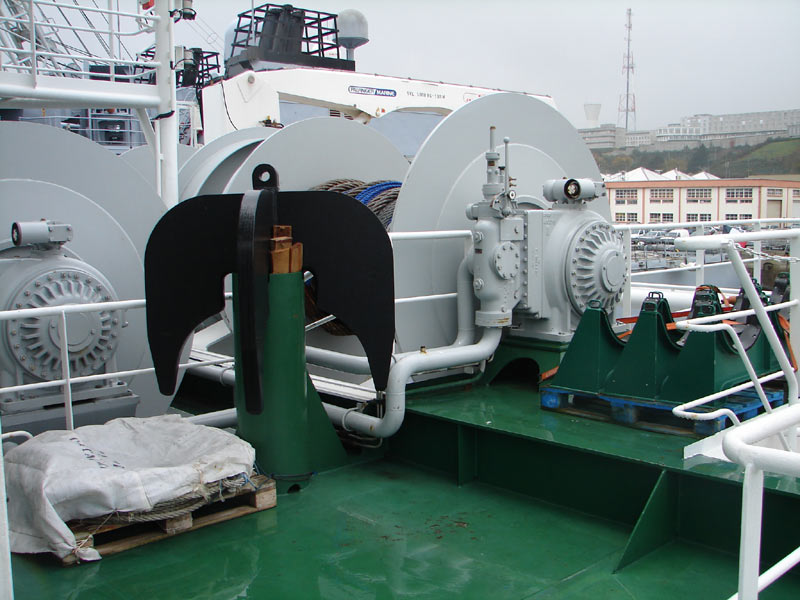
Winches are the workhorses of many commercial vessels – they power anchors, cargo handling gear, mooring lines and towing hawser systems. Because a failure can cripple a ship’s primary mission, operators and technical superintendents must understand exactly what a professional winch service entails, when it is essential, and how to select a reliable contractor that satisfies class societies such as DNV‑GL, ABS or LR.
When a vessel actually needs winch maintenance or repair
Not every vibration or odd sound warrants an immediate shutdown, but several operational patterns reliably signal the need for planned service:
- Cyclic usage intensity: AHTS (anchor handling tug supply) vessels often run their main anchor winches 150–200 cycles per day in harsh North Sea conditions. After roughly 3 000‑4 000 cycles, wear on the gear teeth and drum bearings typically reaches a critical threshold.
- Environmental exposure: Vessels operating in tropical or high‑salinity regions experience accelerated corrosion of steel components and degradation of hydraulic seals. Inspectors commonly recommend a full service every 12 months for ships spending >80% of their time below 30°N latitude.
- Hydraulic oil analysis alerts: A sudden increase in water content or metal particles (e.g., iron >0.5 mg/L) detected by on‑board oil sampling indicates internal wear that should trigger a service before catastrophic failure.
- Noise, vibration and temperature spikes: Measured drum surface temperatures exceeding 70 °C during a standard 100 kN load test or an increase in bearing housing vibration amplitude >2 mm/s is often the first sign of lubrication breakdown.
- Regulatory milestones: Class societies require documented winch inspection and testing at specified intervals (e.g., every 5 years for ABS‑approved anchor winches). Missing these windows can lead to non‑classed status and insurance complications.
Edge cases illustrate why a one‑size‑fits‑all schedule does not work. A multipurpose offshore support vessel may have a dual‑drum mooring winch that is rarely used but must remain ready for emergency deployment; here, condition‑monitoring sensors (load cells, temperature probes) are more reliable triggers than calendar‑based intervals.
What a full professional winch service includes
A comprehensive service package goes far beyond a simple oil change. The typical scope is:
- Documentation review: Verification of as‑built drawings, previous maintenance records and class survey reports.
- Visual inspection & NDT: External examination for cracks, corrosion, misalignment; magnetic particle testing on gear shafts; ultrasonic thickness measurement of the drum wall (minimum 12 mm required for a 400 t‑rated winch).
- Disassembly: Removal of the drum, gearbox and brake assemblies in accordance with OEM torque specifications (e.g., 350 Nm for main gear bolts on a 250 kN electric winch).
- Cleaning & degreasing: Solvent‑based cleaning followed by abrasive blasting where corrosion is present; all parts are then inspected for pitting.
- Lubrication audit: Replacement of gear oil with class‑approved synthetic (ISO VG 46) and re‑measurement of viscosity at 40 °C to ensure it remains within ±10% of the spec.
- Component refurbishment or replacement: New bearings, seals, brake pads, wear plates; for hydraulic winches, a full system flush with filtered oil and replacement of filters, accumulators and relief valves.
- Re‑assembly & torque verification: All bolts are tightened to the OEM sequence using calibrated torque wrenches; alignment checks are performed with laser measurement tools (targeting <0.2 mm axial runout).
- Functional testing: No‑load rotation, load test at 80% of rated capacity, brake release and hold verification, electrical continuity checks for motor windings, and verification of control system logic.
- Documentation & certification: Service report, NDT certificates, updated calibration logs, and a class approval sheet signed by an authorized surveyor (e.g., DNV‑GL Class Surveyor No. 3425).
The above steps can be adjusted for special winch types – for instance, cable‑driven mooring winches on FPSOs often require strand tension monitoring during the load test, while electric deck crane winches may need motor rewinding and inverter firmware updates.
How to evaluate and select a winch service provider
Choosing a contractor is not merely about price; it is about ensuring that the work will stand up to class scrutiny and operational demands. The following checklist helps operators compare candidates objectively:
- Class society approvals: Verify that the provider holds an approved workshop status (e.g., DNV‑GL Approved Workshop No. W‑A1234) and can assign a class surveyor for final inspection.
- Relevant certifications: ISO 9001 for quality management, ISO 14001 for environmental compliance, and if the winch is part of an offshore installation, IEC 60945/60946 certification for maritime navigation and communication equipment may be required.
- Technical competence: Look for engineers with OEM training (e.g., MacGregor, Kone, Lankhorst) and documented experience on the same winch model and vessel type.
- Safety record: Review HSSE statistics; a provider with >2 years incident‑free operation in confined shipyard environments is preferable.
- Spare parts logistics: Ability to source OEM‑approved spare parts within 7–10 days reduces vessel downtime. Confirm whether they maintain an on‑site inventory of critical components (e.g., brake shoes, hydraulic seals).
- Red flags:
- Lack of a written procedure for class surveyor involvement.
- Offers to subcontract major sub‑assemblies without prior disclosure.
- Absence of warranty documentation or indefinite “as‑is” clauses.
- Unexplained price gaps – extremely low quotes often hide omitted scope items.
Typical workflow from mobilisation to hand‑over
A well‑structured process minimises vessel idle time and ensures traceability of every action. Below is a step‑by‑step timeline that most reputable contractors follow:
- Request for Quotation (RFQ): Operator supplies technical data package – winch serial number, rated load, recent inspection reports, class survey requirements.
- Quote issuance & scope agreement: Provider returns a detailed quotation broken down by labour, parts, testing and travel. Both parties sign the Scope of Work (SOW).
- Mobilisation planning: Logistics team arranges transport for dismantled components (e.g., 2 × 20‑ft containers for a 250 t winch) and secures access permits for the shipyard or offshore platform.
- Site safety induction & documentation hand‑over: Contractor’s crew completes vessel-specific HSSE induction, receives lift plans, and reviews the as‑built drawings with the ship’s technical team.
- Dismantling on board: Using a certified crane (often 200 t capacity for large anchor winches), the drum is removed. All bolts are tagged to guarantee correct re‑assembly.
- Transportation to workshop: For high‑value gear sets, specialised air‑ride trailers with vibration monitoring are used; this reduces risk of hidden damage during transit.
- Refurbishment in controlled environment: Workshop temperature maintained at 22 ± 2 °C, relative humidity ≤50% to avoid moisture ingress into bearings.
- Factory Acceptance Test (FAT): The winch is re‑assembled and run through a full load cycle (up to 120% of rated load for ten cycles) while data is logged on a calibrated test rig.
- Re‑installation & sea trial: After returning to the vessel, the contractor aligns the drum with the shaft, reconnects hydraulic lines, and conducts an on‑board acceptance test. The ship’s master signs off once the winch operates within OEM tolerances (e.g., brake release time <0.5 s).
- Documentation & certification hand‑over: Final service report, updated class surveyor certificate, and a warranty register are provided to the operator’s technical superintendent.
Edge cases illustrate flexibility in this workflow. A vessel docked at a remote Pacific island may lack a suitable crane; in such scenarios, the contractor can use a modular floating workshop barge equipped with self‑propelled gantry cranes, allowing on‑site refurbishment without transporting the winch back to a mainland yard.
Three practical tips for operators & superintendents
Even with an excellent service partner, proactive management greatly reduces unexpected failures:
- Maintain an up‑to‑date digital logbook: Record every operational hour, load cycle count and oil analysis result. Linking the log to a CMMS (Computerised Maintenance Management System) enables automated alerts when thresholds are reached.
- Implement predictive condition monitoring: Install vibration sensors and temperature probes on critical bearings; set alarm limits based on OEM baseline data. Early trends allow you to schedule a service before a bearing reaches the “run‑to‑failure” stage.
- Keep a strategic spare‑parts inventory: For high‑risk components (e.g., brake shoes, hydraulic seals), maintain at least one spare unit on board or within a 48‑hour delivery radius. This eliminates the need for extended dry‑dock periods when an unexpected part failure occurs.
FAQ
What class societies accept third‑party winch refurbishment? All major societies – DNV‑GL, ABS, LR, BV – recognise approved workshops that follow their procedural guidelines and allow a surveyor to witness the final test. The workshop must hold an official approval number.
How often should hydraulic winches be flushed? A standard practice is a full oil flush every 12 months or after any major contamination event (e.g., water ingress). Some operators adopt a 6‑month interval when operating in tropical waters where moisture buildup is faster.
Can I combine winch service with other deck‑equipment maintenance? Yes, and it is often cost‑effective. Coordinating crane, capstan and winch work during the same shipyard visit reduces mobilisation fees and vessel downtime.
What warranty coverage is typical for a refurbished winch? Reputable providers usually offer a 12‑month warranty on labour and replaced parts, with an optional extension to 24 months. Warranty terms must be clearly stated in the service contract.
Is it possible to certify a winch after a non‑class approved repair? No. If a winch is repaired by an unauthorised workshop, the class society will require a full re‑inspection and may deem the equipment non‑compliant until proper certification is obtained.